






 Posts
Posts


Friday, October 25, 2013
Where are board and card games headed?
Where are board (and card) games headed? Predicting the future is fraught with perils. Sometimes a collective group can come up with a little better projection than any individual - and sometimes not. So I'm going to try to peer into a murky crystal ball about the future of boardgames and card games, and see what the collective has to make of it.
But even if we could come to a consensus, as unlikely as that is, about the future of board and card games, what actually happens in history is often not what's most likely to happen. So even if we accurately predict what's most likely to happen, there's a good chance something else will happen. Which may ultimately be what makes a statesman's job so difficult.
Following where video games lead
I think we'll follow the lead of videogames in many respects. I'm not saying that video games set the trend, but they react to what the populace wants, perhaps faster than board and card games, and of course vastly more people play video games than board and card games. (You may have heard that Grand Theft Auto V made over a billion dollars (yes, with a B) in the first couple days of sales worldwide - $800 million the first day.)
We're obviously moving towards simpler and shorter games. It's just about impossible to achieve the ideal that video games already enjoy, which is that someone can play the game without reading any rules. But simpler games mean there are less rules to read and understand.
Also we'll find more games that effectively tell the player what to do next. This has become common in video games, for example, in single player games where the helping hand is always there. For a game to tell people what to do next might be a little peculiar when there's two or more players in opposition, but when it's a puzzle/contest, multiplayer solitaire, then it won't be seen as so odd. All cooperative games are essentially single player and we'll certainly be seeing more cooperative games as we go toward more puzzles and less direct conflict/competition.
Discoverability and what it's done to game design
Discoverability is a huge problem in the video game industry as thousands of small-scale games are released every month. The really good games are being overwhelmed by the crap, much as happened in the great videogame crash of the early 80s when so many crappy Atari games were released that finally no one bought any games at all. Nintendo fixed that problem when they came along by controlling all manufacture of games for their console, thus limiting the supply and eliminating most of the crap.
Even if your game is very good, if someone doesn't know your game exists, he can't buy it or play it. We're getting to that point in board and card games. I was told there were 800 new tabletop games at Essen last year and I suppose that number was closer to 1000 this year. As a result, just as in the video game world, the *marketing* possibilities of a game become much more important than whether it's a good game to *play*. In the video game world few games are played very long before someone moves on to the next game, and I see this phenomenon has become common in the tabletop world where a typocal game is only played one or two or three times before players move on to something else. The games don't have to be good games in the old sense of games that you enjoy playing over and over and over again, rather they have to be games that have a marketing hook and that look good and sound good when described (the latter especially for Kickstarter, which often amounts to "smoke and mirrors"). And not surprisingly, the typical published game is pretty weak, especially those coming out of Kickstarter.
Furthermore, publishers are bombarded with so many game prototypes that they focus very much on marketing and don't generally have a chance to find out whether a game is good enough to be enjoyably played even 25 times, let alone 500 times. Kickstarter games are almost all marketing because in most cases no one has a chance to know how well they play before they fork over their Kickstarter support money. This is a great contrast with the past when, if you designed a game that was really good to play, you had a significant chance of getting it published. Now whether the game is really good to play in the long run is, if not pretty unimportant to the publisher, something that's no longer vital.
Computer gaming as an adjunct or replacement for board gaming
I think that the iPad may become the new board game platform for *two player* games. People have less and less time to play games and this pushes them toward the casual end of the spectrum, as opposed to the hard-core who can sit for several hours to play a game or several games. In typical game club contexts, almost all the games played are for more than two, except for CCGs - and I see a lot of CCG sessions for four or more people now. What the iPad offers is games in small snippets, as in the Battle of the Bulge game by Shenandoah of Philadelphia. (See my post of September 3: http://pulsiphergamedesign.blogspot.com/2013/08/gencon-and-wbc-2013.html ) The iPad provides a convenience that boards or big layouts of cards on the table simply cannot provide, and it makes it easy to preserve the state of the game when it cannot be completed in one sitting. I did say iPad, but I mean tablets in general; however, people are much more willing to pay for iPad apps than for Android apps, and there is much more piracy in Android, so it appears that the platform for developers is much more the iPad specifically than the tablet. (Free to play (F2P) games can go onto Android, I'm talking about games that cost money to buy. But even in-app purchases in F2P games are being heavily pirated nowadays.)
As smartphones become ubiquitous, we may see more boardgames that require (or offer optional use of) a smartphone to track information and do calculations that today's gamers may find annoying, if not difficult.
Cardgames rising, boardgames descending
It appears to me also that cardgames are becoming more popular and boardgames less. This is what's happening with FFG's lines, I've noticed. This is quite apart from Magic, which is massively popular (some $270 million a year). There are several reasons for this. One is that it is easier and cheaper to provide colorful visuals with cards, than with the board and pieces. Visuals on the cards don't generally have anything to do with the play of the game, whereas the visuals on a board are usually important to gameplay, and so cannot be fooled around with. Now there are exceptions to this like Smallworld which has such a busy looking board that when you put the pieces on the board it's very hard to see them. But this hasn't prevented Smallworld from becoming quite a popular game. (It is one of the great puzzles to me that an out and out wargame has become popular among Euro players, furthermore, a wargame that is broken, compared to the predecessor by the same designer (Vinci), and which has dysfunctional graphic design. *Shrug*)
Another reason is that cardgames are naturally shorter than boardgames, if you consider each "hand" individually. Moreover, it's easy to limit the length of a cardgame by relating length to the draw deck (if there is one), a limit that feels less arbitrary than a given number of turns.
Thirdly, one of the great advantages of a game that's primarily cards is that you can put the rules (and especially, the exceptions to the standard rules) on the cards, and this makes it easier for someone to read the game rules so they can teach other people to play the game. (They don't have to read the cards to learn to play, they can read them as the cards turn up.) Also, the great popularity of Magic: the Gathering (which grew by more than a third last year) and Yu-Gi-Oh makes certain kinds of mechanics that are used with cards quite familiar to a large number of gamers. At the NC State tabletop gamers club last year, often more than half of the players present were Magic players rather than players of boardgames and other cardgames. (This has changed markedly when meetings moved from Thursday to Friday this year; some suggest that the organized play at game shops on Fridays has drawn off the CCG players.)
Furthermore, a cards-only game tends to limit what can be done by the player, and especially limits the gameplay depth of the game as compared to a game that can use both boards and cards and perhaps other elements as well. But there's great potential for variety in the form of additional cards and decks of cards. In this century variety seems to be displacing gameplay depth as the most desirable aspect of play of a game.
Positive and Rewarding
Video games in the age of free-to-play are rapidly going away from the idea that you have to earn something in the game to the idea that games are constant rewards, constantly positive. In this century egos are fragile and people not only don't like to be frustrated, they don't like to move out of their comfort zone at all. This will certainly be reflected in boardgames and card games. Part and parcel of this is the de-emphasis of competition. We'll have more games that are puzzles (you can't lose to a puzzle) and more co-ops that are essentially single player so that no player is putting his or her ego on the line. Consequence-based gaming is being replaced in the video game world with reward-based gaming, and the same thing is likely to be expressed to some extent on the tabletop.
Game players versus game buyers
There are three different groups of gamers that I have been involved with in the past several years.
One group is mostly-over-40 third-Friday-of-the-month boardgamers who are increasingly Euro oriented and increasingly part of the Cult of the New. A fair number of those folks, although certainly a minority, buy games fairly regularly.
The second group is video gamers who were students in my classes, and of course they didn't buy boardgames at all because they had not been exposed to them, although some of them were perfectly happy to play them at the game club (not during class hours - though they would've been happy to do it then too!). They bought some video games, but they also pirated a lot and played a great many free-to-play games.
The third group is at a University tabletop game club that has existed for seven or eight years. Only two or three other members actually buy games, while the club buys a few games each year with membership dues (which are optional). Most of the players are happy to play their favorite games week in and week out, such as Betrayal House on the Hill, Red Dragon Inn, Bang! , recently Munchkin, and others. They are not Eurostyle players per se because they're perfectly happy to play directly competitive games where players can easily hinder or harm one another in the game. Many of them are just as interested in the social aspects of being with a group of people to play games as they are in the specific game that they play. The majority of them play video games as well, though usually free ones, and many are also RPGers. Very few of them are involved with Boardgamegeek.
So we have a lot of game players who are not game buyers. From the point of view of the future of the board and card game hobby how do we regard these folks? They play games but they don't buy games. They provide players for the people who do buy games. But they don't put any money directly into the industry. So are they part of the hobby but not part of the industry?
The videogame industry is faced with problems that mobile games can rarely be sold for more than a pittance ($.99), and most people who play free to play games never spend a dime on them. Combine this with rampant piracy and it's becoming hard to make money on a mobile game. (http://www.gamesindustry.biz/articles/2013-09-24-game-devs-ditching-mobile-in-favor-of-pc-console) Perhaps this is more or less the equivalent of having so many tabletop gamers who don't actually buy games. But the one great blessing we have in the tabletop industry is that it's hard to pirate a physical game, though you can pirate RPG books and rulebooks easily.
Self-publishing
A really safe prediction is that self-publishing will continue to grow, whether through POD like thegamecrafter.com, or through crowd-funded games. Self-published games inevitably tend to be of lesser qualtiy as games (ignoring the physical quality), just as self-published books tend to be a lesser quality than those going through traditional publishers. Will Kickstarter failures (funded but no game is ever published) and general low quality of self-publishing ultimately lead to the kind of crash that affected video games in the early 80s? Who knows?
The "Cult of the New"
My wife (who I met through Dungeons & Dragons), dislikes any changes in how the audiovisual and computer equipment works in the house. She is the opposite of worshipers of the "Cult of the New". But she's also not a game player. To go back to my three groups of gamers, the college aged tabletoppers are happy to play the same games over and over again but are also happy to play new games. But the Cult of the New is not noticeable. On the other hand, they don't buy games. BoardGameGeek, which is seen by publishers to be very influential in game buying, is a stronghold for the Cult of the New. Is there something about game players - or I should say, game buyers - that makes them more likely to be part of the Cult of the New? From a publisher's point of view the Cult of the New means people who do buy games are likely to buy more games than fewer. But it seems to mean that buying is spread out over more games and so each game sells less than in the past, which is not good for publishers.
A Decrease in Design Quality
Many of the games being sold (or at least, demoed) at Origins or GenCon don't need to be very good designs. (I'm talking about the design, not the graphics/marketing hooks.) They only need to be good enough to be interesting for several plays, because the fate of most games is to be played only a few times before the owner goes on to the next game. There are lots of reasons for this, e.g. the short attention span of the "Internet generation", and the vast number of games out there calling for play. Moreover, in a "demo" environment such as a game convention players are strongly affected by "cool", which is often in graphics or theme, because they don't have time to learn whether the game actually has much to it, whether it can last more than a few plays.
As a result, a lot of these games simply aren't very good. In a way it's like video games: most of the published ones aren't really very good, time killers more than anything else, though they may sound good or look good. And that doesn't count the 90% that are funded but never see the light of day. Board and card games are much less time-consuming to produce, so more of the "90%" are likely to actually be published/self-published.
(Not very good: as far as I'm concerned, a game that's only good for killing time isn't very good. Whether it's played a lot by people or not. (Card Solitaire is an example, 'course that's really a puzzle, not a game.))
Result: a lot of weak games. Yet they all compete with the good games. Unfortunately much of the sales process does not depend on how good the game design is, so the result is that the good games sometimes suffer, getting less sales and attention than they deserve.
Lower sales of individual games
And that brings us to the last "prediction", that sales of individual games will continue to fall, though that may not be true for the several really big hits each year. The total sales of games may be climbing, but that doesn't help publishers whose profit depends heavily on the cost per unit. The more copies of a single game you can print (which means, you can sell), the lower the cost per unit. If sales are spread over a much larger number of titles, publishers then become more dependent on hits, and even though we as gamers spend more money on games, publishers don't make more money, they make less.
This is not very optimistic. For an optimistic view, see Mary Couzin, "Establishing New Connections Through Board Games" http://viewer.zmags.com/publication/f5cf956a?page=42#/f5cf956a/43


Monday, October 21, 2013
October 2013 Miscellany
Thoughts about some game-related topics that are not long enough for separate blog posts.
**
I was reading a free RPG ruleset recently. " features a long and exciting list of rules that are outside the normal scope of today‘s top most role-playing games." How many gamers get excited by the rules? The rules are only a means to allow a game to be played. It's the play of the game, if anything, that should be exciting. *Shrug*. Perhaps the domination of the tabletop market by D&D/Pathfinder frustrates RPG designers who want to do things "differently".
**
Looking at the analytics for my free game design class, I'm astonished that Chrome is used more than twice as much as Firefox. (Top 2) Internet Explorer is even behind Safari (MAC).
**
How reliable are reviews of games and game-related materials? One thing you can do is compare reviews from different sources. Of course, if you look at Metacritic you sometimes see a wide variation in the number ratings for particular games.
But here's a striking example. GameInformer rates the Alienware 14 gaming laptop 8 out of 10 (very good), and in particular "loved the gentle feel of the systems soft-touch rubber keys" (which, I confess, sounds bad to me as a typist or a gamer). PC Gamer gave it 56 out of 100 and heavily criticizes the trackpad on that same keyboard. Five laptops in that review got much better ratings, only one worse.
**
For all of its colorful presentation, Magic: the Gathering is an abstract game. Only by the greatest stretch of the imagination can you say that player actions, or occurrences in the game, correspond to something that happens in a (fantasy) reality. There's no "analgousness" to any real (or fictional) reality. Nor do I believe the designers think in terms of modeling something, they are thinking about how to improve (or just change) an abstract game. The atmosphere is tacked on.
**
Gamer Psychology can be really odd. There are many (most) people who always want to know what they need before they roll dice, when they could save time by rolling first, then figuring it out if it isn't obviously too low or easily high enough. (One person says, well it's good practice to become familiar with the mods. But most people do it even when they know all the mods. ) It's as though the player subtly thinks he can influence the dice roll. Sure wastes time, though.
**
Some articles I've recommended through twitter:
Warren Spector: Industry must recognize both good and bad effects of games http://www.gamesindustry.biz/articles/2013-10-07-spector-industry-must-recognize-both-good-and-bad-effects-of-games
Game Developer Magazine complete archives: http://gdcvault.com/gdmag?goback=.gde_59205_member_275507544#
James Mathe lists Facebook groups that may be helpful to game designers and publishers: http://www.jamesmathe.com/facebook-pages-groups/
Some thought-provoking insight on games and stories from Chris Crawford: http://www.gamasutra.com/view/news/200989/Whats_Next_Chris_Crawford_says_storytelling_is_our_greatest_challenge.php
Eric Zimmerman's How I Teach. (prologue): http://ericzimmerman.wordpress.com/2013/09/15/how-i-teach-prologue/
Warren Spector's "commandments" of game design
http://www.gamesindustry.biz/articles/2013-09-04-warren-spectors-commandments-of-game-design
Ian Bogost What are MOOCs good for? For proving that MOOCs might be good if they were good. http://chronicle.com/blogs/wiredcampus/lessons-learned-from-a-freshman-composition-mooc/46337
Parody of game design school commercials (stick with it) :http://www.youtube.com/watch?v=o0o9AflX7yg
Most Dangerous Game Design: Scaffolding Choice: Ease Players into a Game's Choices. http://www.mostdangerousgamedesign.com/2013/09/scaffolding-choice-how-to-ease-players.html
Extra Credits: Game Schools. (The Truth.) http://www.youtube.com/watch?v=nmdGZk-fF98
**
Occasionally I encounter people who are absolutely convinced that there are no generational differences, even though businesspeople widely recognize and account for such differences. Think about this and then ask yourself why my point of view as a Baby Boomer is very different from the point of view of a Millennial (30 and under, more or less):
When I was a kid in the 50s and 60s, if you were lucky you had three black and white television networks to watch instead of two, there was no Internet and consequently no e-mail, no cell phones, slide rules not personal computers (or printers, CDs, or DVDs), no World Wide Web, no Facebook, no Twitter, no YouTube. A long distance call of any length cost real money. We had a "party line" phone shared by four households, which was common, so you listened to the ring to determine whether the call was for you or another party with the same line, and if you picked up the phone while someone else on the party line was having a conversation, you heard it all. If you had an emergency and someone else was already using the line, you'd have to ask them to get off so you could make the emergency call.
I first saw color TV in a person's house when I was 10 (trick-or-treat: the owners let the kids come in and see their cool color TV). Books and magazines and newspapers were the major sources of information, not radio, not TV, not the Internet. (Though if you wanted the most up-to-date news, you listened to the radio.)
Music was on 8-track tapes and vinyl LPs (33 and 45 revolutions per minute, though older 78 still existed). If you wanted to watch a movie, if on TV you stayed up after 11 (old movies only), or you went to a theater, there was no way to record a movie other than film. If you wanted a single song after its initial popularity you had to luckily find an out-of-print 45 or you bought an entire album. Or, once cassette tape became available (but by this time I was an adult), you recorded it from the radio.
There was no instant replay on sporting events because videotape had not been perfected. There was no three point shot in basketball, dunks were illegal for a few years, and high school women's basketball was played six a side with only two allowed to play both offense and defense. There not only was no Superbowl, the NFL championship game was not televised until several years after I was born.
Communication satellites came into use when I was a teenager, before then our foreign news came onto TV only with voice, via telephone undersea cables. The biggest recent events in the minds of adults were World War II, the Korean War (I was born during the Korean War), and the continuing Cold War. Nuclear Annihilation was on everyone's mind, an ever-present danger. (When I was 11 I walked home from school a few miles, alone, to test the possibility for sending everyone home that way if the Cuban Missile Crisis turned into a war.) Terrorism was something that happened far, far away.
My mother had grown up during the Great Depression. She would do things like collect the little bits of bar-soap left after use and melt them together to make new multi-colored bars for us to use. Waste not, want not. How many people do anything like that today, even the officially poor people?
I remember at age 9 watching the United States Army ensure a black girl could go to school in Little Rock, Arkansas - because the local National Guard couldn't be trusted to do it. I was 17 or 18 the first time a man and woman, one black, one white, kissed on national TV. No one expected we'd have a female or black president in our lifetimes. Same-sex marriage was impossible. "Made in Japan" was a bit of a joke. The Japanese were former badguys seen on war movies (and adults all remembered "the war"), not the objects of near-worship by young people that they sometimes seem to be in the age of anime.
In that era, as for generations before, a book was a treasure trove of information, something to be read carefully and absorbed as much as possible.
Nowadays people are much less impressed by books because there's so many other sources of information, but if you really want to learn about something in depth a good book is a really good way to do it.
Makes for a quite different point of view. Yes, I know what Plato says that Socrates said about young people. This is not "oh, old people always say that", this is a result of real differences in life and culture, which change much faster than they used to.
**
I was reading a free RPG ruleset recently. "
**
Looking at the analytics for my free game design class, I'm astonished that Chrome is used more than twice as much as Firefox. (Top 2) Internet Explorer is even behind Safari (MAC).
**
How reliable are reviews of games and game-related materials? One thing you can do is compare reviews from different sources. Of course, if you look at Metacritic you sometimes see a wide variation in the number ratings for particular games.
But here's a striking example. GameInformer rates the Alienware 14 gaming laptop 8 out of 10 (very good), and in particular "loved the gentle feel of the systems soft-touch rubber keys" (which, I confess, sounds bad to me as a typist or a gamer). PC Gamer gave it 56 out of 100 and heavily criticizes the trackpad on that same keyboard. Five laptops in that review got much better ratings, only one worse.
**
For all of its colorful presentation, Magic: the Gathering is an abstract game. Only by the greatest stretch of the imagination can you say that player actions, or occurrences in the game, correspond to something that happens in a (fantasy) reality. There's no "analgousness" to any real (or fictional) reality. Nor do I believe the designers think in terms of modeling something, they are thinking about how to improve (or just change) an abstract game. The atmosphere is tacked on.
**
Gamer Psychology can be really odd. There are many (most) people who always want to know what they need before they roll dice, when they could save time by rolling first, then figuring it out if it isn't obviously too low or easily high enough. (One person says, well it's good practice to become familiar with the mods. But most people do it even when they know all the mods. ) It's as though the player subtly thinks he can influence the dice roll. Sure wastes time, though.
**
Some articles I've recommended through twitter:
Warren Spector: Industry must recognize both good and bad effects of games http://www.gamesindustry.biz/articles/2013-10-07-spector-industry-must-recognize-both-good-and-bad-effects-of-games
Game Developer Magazine complete archives: http://gdcvault.com/gdmag?goback=.gde_59205_member_275507544#
James Mathe lists Facebook groups that may be helpful to game designers and publishers: http://www.jamesmathe.com/facebook-pages-groups/
Some thought-provoking insight on games and stories from Chris Crawford: http://www.gamasutra.com/view/news/200989/Whats_Next_Chris_Crawford_says_storytelling_is_our_greatest_challenge.php
Eric Zimmerman's How I Teach. (prologue): http://ericzimmerman.wordpress.com/2013/09/15/how-i-teach-prologue/
Warren Spector's "commandments" of game design
http://www.gamesindustry.biz/articles/2013-09-04-warren-spectors-commandments-of-game-design
Ian Bogost What are MOOCs good for? For proving that MOOCs might be good if they were good. http://chronicle.com/blogs/wiredcampus/lessons-learned-from-a-freshman-composition-mooc/46337
Parody of game design school commercials (stick with it) :http://www.youtube.com/watch?v=o0o9AflX7yg
Most Dangerous Game Design: Scaffolding Choice: Ease Players into a Game's Choices. http://www.mostdangerousgamedesign.com/2013/09/scaffolding-choice-how-to-ease-players.html
Extra Credits: Game Schools. (The Truth.) http://www.youtube.com/watch?v=nmdGZk-fF98
**
Occasionally I encounter people who are absolutely convinced that there are no generational differences, even though businesspeople widely recognize and account for such differences. Think about this and then ask yourself why my point of view as a Baby Boomer is very different from the point of view of a Millennial (30 and under, more or less):
When I was a kid in the 50s and 60s, if you were lucky you had three black and white television networks to watch instead of two, there was no Internet and consequently no e-mail, no cell phones, slide rules not personal computers (or printers, CDs, or DVDs), no World Wide Web, no Facebook, no Twitter, no YouTube. A long distance call of any length cost real money. We had a "party line" phone shared by four households, which was common, so you listened to the ring to determine whether the call was for you or another party with the same line, and if you picked up the phone while someone else on the party line was having a conversation, you heard it all. If you had an emergency and someone else was already using the line, you'd have to ask them to get off so you could make the emergency call.
I first saw color TV in a person's house when I was 10 (trick-or-treat: the owners let the kids come in and see their cool color TV). Books and magazines and newspapers were the major sources of information, not radio, not TV, not the Internet. (Though if you wanted the most up-to-date news, you listened to the radio.)
Music was on 8-track tapes and vinyl LPs (33 and 45 revolutions per minute, though older 78 still existed). If you wanted to watch a movie, if on TV you stayed up after 11 (old movies only), or you went to a theater, there was no way to record a movie other than film. If you wanted a single song after its initial popularity you had to luckily find an out-of-print 45 or you bought an entire album. Or, once cassette tape became available (but by this time I was an adult), you recorded it from the radio.
There was no instant replay on sporting events because videotape had not been perfected. There was no three point shot in basketball, dunks were illegal for a few years, and high school women's basketball was played six a side with only two allowed to play both offense and defense. There not only was no Superbowl, the NFL championship game was not televised until several years after I was born.
Communication satellites came into use when I was a teenager, before then our foreign news came onto TV only with voice, via telephone undersea cables. The biggest recent events in the minds of adults were World War II, the Korean War (I was born during the Korean War), and the continuing Cold War. Nuclear Annihilation was on everyone's mind, an ever-present danger. (When I was 11 I walked home from school a few miles, alone, to test the possibility for sending everyone home that way if the Cuban Missile Crisis turned into a war.) Terrorism was something that happened far, far away.
My mother had grown up during the Great Depression. She would do things like collect the little bits of bar-soap left after use and melt them together to make new multi-colored bars for us to use. Waste not, want not. How many people do anything like that today, even the officially poor people?
I remember at age 9 watching the United States Army ensure a black girl could go to school in Little Rock, Arkansas - because the local National Guard couldn't be trusted to do it. I was 17 or 18 the first time a man and woman, one black, one white, kissed on national TV. No one expected we'd have a female or black president in our lifetimes. Same-sex marriage was impossible. "Made in Japan" was a bit of a joke. The Japanese were former badguys seen on war movies (and adults all remembered "the war"), not the objects of near-worship by young people that they sometimes seem to be in the age of anime.
In that era, as for generations before, a book was a treasure trove of information, something to be read carefully and absorbed as much as possible.
Nowadays people are much less impressed by books because there's so many other sources of information, but if you really want to learn about something in depth a good book is a really good way to do it.
Makes for a quite different point of view. Yes, I know what Plato says that Socrates said about young people. This is not "oh, old people always say that", this is a result of real differences in life and culture, which change much faster than they used to.
Monday, October 07, 2013
Competition, direct conflict, wargames, and screwage games
Hard-core gamers are much more inclined to like competition and direct conflict than are casual gamers. Part of this is because casual gamers tend to like short experiences while most games that have direct conflict are longer games, which allows that conflict to “play out”. Another might be that hard-core gamers are satisfied with or even crave the tension that comes from direct conflict while casual gamers are more likely to be trying to relax and are not looking for a lot of tension. Another reason might be that hard-core gamers are more willing to accept the frustration of direct opposition, of having obstacles that take some doing to overcome, as opposed to the casual gamers who want to see things happen in a game but not interested in being opposed. (Think of popular casual video games like Bejeweled and Tetris. There's only randomness, not opposition.)
Let’s differentiate between competition in general, and direct competition/conflict. You can compete in a contest where you never actually can affect the other player, you're just comparing results. Typing for five minutes and declaring the winner to be the person who typed the most correct words is a contest, and can be seen as a form of competition but is not a conflict. Hard-core video gamers often compete via contests, comparing their scores in various games or how long it took to "beat the game" as they play the same game but do not play each other: for example "I scored 17,000 in Tetris and you only scored 15,000 so I beat you" even though the players played solo because that's the nature of the game.
Wargames are almost always direct conflict, it's the nature of warfare. So people who are in the "wargames ghetto" as I've called it since I came back into the hobby eight or nine years ago, the ones who play lots of hex-and-counter wargames, are inevitably in conflict when they play one another. But SPI used to say many years ago that 50% of their games were played solo, and I think that's probably still true, that people play the wargames solo in order to experience (and experiment with) the history rather than for the conflict itself.
Wargames generally involve organized groups, usually governments, fighting each other either in short-term battle or long-term war. What kind of direct competition can we have that doesn't involve warfare? Business competition can often involve direct conflict, economic competition can certainly involve direct conflict, and individual competition can involve direct conflict. For example role-playing games are not about warfare usually but are direct conflicts. The big difference there is that they are cooperative games because one side of the conflict, the bad guys, the monsters, is controlled by a more or less neutral referee. In that respect they're like single-player video games except that a human referee can always be much more inventive than any computer program at this point in history. But in the video game world, especially MMOs, what has the trappings of an RPG can become direct conflict via the “PvP” (player versus player) mode of the game.
So we can have games that involve direct conflict but are not wargames per se. Sometimes that direct conflict involves violence (as in the MMO), sometimes not (as in the economic or business game). Sometimes these are what I call “screwage games”. These games for from three to many players are usually directly competitive but do not require a lot of reasoning for success, games that involve a strong dose of chance as well as skill. The games are more colorful than serious. Players are not focused on winning, they are focused on having a good time messing with their friends. They can be played the strangers as long as it’s played within a social context, such as at a game club with lots of other people around. The narratives of these games, that is the accounts of what happens, can be quite interesting or amusing, but the games themselves are not complex. The narratives can amount to pretty good stories, sometimes. And there is usually a fair bit of variety/replayability.
People who are very focused on winning aren’t likely to enjoy any screwage game.
In most cases a screwage game is played by a group round a table, with hands of cards, and simple scoring. “Beer and pretzels” is another term that’s often used for this kind of game, although it also includes other kinds of games so I’ve decided to use a different term. You could say that screwage games are a subset of beer and pretzels games. Screwage games are not usually “Take That” games; though there certainly can be cards that have striking effects, it’s not usually the case that a single card can vault someone from a poor position/situation to a good one.
Player elimination seems to be acceptable in many well-known screwage games but it’s not at all desirable. How can you mess with your friends when you’ve been eliminated from the game?
Give a screwage game to strictly Eurostyle players and sometimes you’ll end up with bewildered looks, as the game is so different from the games with little or no direct conflict that they’re used to.
One of the most well-known screwage games, although one with a severe design flaw from the point of view of really good game players, is Munchkin. (And I'll admit here that I don't care for Munchkin because the humor is silly and wears off very rapidly.) The design flaw is that there is rampant leader bashing and when the game is played by people focused on winning it becomes constant leader bashing until everybody is near the goal and finally somebody breaks through. But Munchkin is a very, very successful game because most people who play screwage games are not focused on winning, they're focused on messing with their friends and having a good time with others, and they don’t worry about the flaw (or don’t even realize it’s there, rather like the long-distance ticket flaw in original Ticket to Ride).
Nuclear War is one of the very early screwage games. While it theoretically depicts warfare between countries, for all practical purposes it's warfare between individuals.
Bang! is another screwage game that has been very successful, including a knockoff Three Kingdoms game that is very popular in China. Bang! is about the old West, the conflict between the sheriff and possibly deputies and outlaws, and people are shooting each other, but it's not warfare per se. Bang! relies heavily on unknown roles - although the role of the sheriff is known - and also has a mechanism that involves the range of your weapons so that you cannot attack anyone you want any time. This contrasts with some of the leader bashing that we see so rampantly in Munchkin when there's a fight, because anybody can join in in Munchkin. Whenever you can always target the leader then you're likely to have rampant leader bashing, especially if it's obvious who the leader is. In Munchkin you know everyone’s level, and reaching the target level is how you win.
Should you contemplate design of a screwage game - I’ve designed several, as they go over quite well at the university game club, especially when the subject is something like pirates or zombies or surviving the apocalypse - then be sure to limit in some way the ability of a player to attack every other player. Otherwise you may end up with a game with a Munchkin-like flaw.
Friday, October 04, 2013
Really Small Games
Some time ago I was designing a couple games that are so small you couldn't even call them microgames. Maybe nano-games would do? At the World Boardgaming Championships in early August I saw yet again the postcard-size wargames that "Against the Odds" magazine gives away as promotional materials. The entire game is on the postcard, board on one side, rules on the other side, 17 to 20 half inch pieces printed along the edge.
As I've said many times before, I think that restrictions and constraints help one actually create better work. Beethoven benefited from the rules of classical music even as he sometimes broke those rules. Modern painting is so god-awful, at least in my opinion, because there are no rules. If you give a novice game designer carte blanche to design whatever they want they often flail around and then try to do something completely impractical. A postcard size game, on the other hand, introduces tremendous constraints.
As my favorite game is the game of designing games, this was an interesting project to attempt. Having worked up two of them and played one with the other about to be played, I can say that this format requires you to decide what is the essence you want people to learn from the game. These are not games that people are going to play over and over again because there is so little there. So when they play I want them to understand the essence of the historical situation, what was really important. And that can be done even in this small format, although there is no room for the designer to then explain the reasoning behind his choices.
For example, the first game is about the raids of the "Great Heathen Army" on Frankia in the late ninth century, after they’d been stymied by Alfred the Great in Britain. It is a solitaire game with the player trying to defend Frankia from randomly determined attacking Vikings. The player does not know the strengths of either the Vikings or his own troops. He doesn't know the strength of the Vikings because it was so hard to collect and then communicate information in that era, and the Vikings could move by boat much, much faster than the Franks could move on land. He doesn't know the strength of his own troops because both raising those troops and getting them to fight was so unreliable. (At this point the Franks actually had a capable king, which was exceptional.) The Vikings are especially likely to go upriver, and that's reflected in the dice rolls to determine their actions.
I have doubts that I'll be able to get all the rules into a format of about 600 words, we'll see.
The second game is the First Battle of Savo Island, during the American invasion of Guadalcanal. The Japanese were immensely better at night fighting than the Americans, aided by having immensely better torpedoes (and lots of torpedoes on their cruisers, which the Americans either didn't have or didn’t use). The American guarding force got crushed but the Japanese turned away rather than tear into the American transport fleet. So the game needs to reflect those spotting limitations and the difference in torpedoes. And once again I use the uncertainty of face down pieces to try to represent the confusion of night fighting.
When you have so few pieces you must make them do double-duty. Either they must have “steps,” so that you can turn the piece over when hit to show the weaker side, or they must simulate "fog of war" to provide uncertainty, so players see only the blank side of the opposition much of the time. In the Viking game some of the pieces are "0's", which are decoys on the Viking side, failures of recruitment and leadership on the Frankish side, but this is not revealed until there's a battle. There are a few decoys in Savo, too, but also a non-decoy piece can be as weak as a couple destroyers or as strong as a couple heavy cruisers.
Nano-games tend to be tactical rather than strategic - though I have to say my Viking game is more strategic than tactical. The board and piece limitations don’t provide much room for the flexibility of a game with economic production, which is often a component of strategic games.
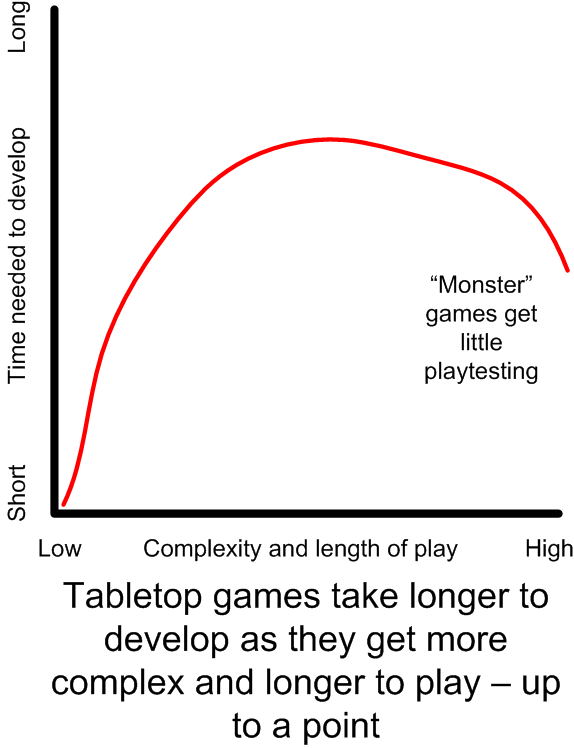 A virtue of designing "nano-games" is that they take less time to create and to balance. The accompanying diagram reflects this notion. Notice at the end, the "monster tabletop games" of a thousand pieces and enormous boards, the time goes down. That's because such games are bought more for the information than to actually play, and are rarely playtested more than a few times during design. Playtesting, of course, takes up most of the time in designing almost any game.
(Most of my blog hosts don’t handle diagrams well, so you may need to go to http://pulsiphergames.com/images/XY_length_development.gif
to see this diagram.)
Wednesday, October 02, 2013
What do RPGs amount to, what are you actually designing (if you do the whole thing)?
Just trying to get this straight in my mind. I’ve never designed an entire RPG, and probably never will, nonetheless it’s well to know exactly what’s involved.
1) A set of mechanics to govern play of the game - the actual “game design.”
2) A world-setting, which could be a time (era) for familiar worlds (such as, medieval Europe or ancient Rome for an earth-like world), or an entirely different world that nonetheless may resemble Earth and earthly history in some ways. E.g. Middle-earth, Spelljammer.
Some settings don’t make much difference to the play - they’re atmospheres, not themes. In other cases, the setting makes a big difference to how the game is constructed and how it’s played. Consider, say, AD&D settings like Spelljammer where there are many additional spells and such, and where the play tends to be quite different from the old standard “dungeon/wilderness exploration”.
World and setting are actually two separate-but-related things. In our world there are lots of possible settings, but lots that are not possible (those involving magic or starships, e.g.).
3) This world-setting includes a definition of the state of technology (science) and magic. At some point technology and magic look the same (remember Arthur C. Clarke’s dictum that any sufficiently advanced technology is indistinguishable from magic). But technology tends to have scientific trappings while magic is usually wrapped in mystery. Moreover, is there lots of magic or technology in the setting, or only a little? Are “14th level wizards” (extraordinarily powerful wizards) common, or as rare as US senators (less than 1 in 3 million people), or unknown (in Third Age Middle-earth there was only one, Sauron) or somewhere in between? Is magic used to substitute for functions where we in the real world use technology? Does the populace approve of magic, or fear it? Is magic based on religion, on the elements, on “mind-power”, etc.
4) The world setting, and even the rules, have a strong bearing on the stories that are part of RPGs. But often the published game will include only some overarching stories that are wrapped up in the particular world setting, or maybe no stories at all.
5) Adventures. Adventures are mostly published separately, though there may be introductory adventure(s) with the published game. Adventures have their own stories within the context of the overall world-setting. Maybe there's also an overarching story that affects all adventures (perhaps as simple as a war between good and evil), maybe not.
6) (Moral) Tone and (player) Angle. This “player view” is something I added late in the day as I made this list. I refer to the overall purpose and “world-view” of the game, from the players’ point of view. This can be drastically altered by the referee, but each game starts somewhere. Here is where we run into such tonal questions as “how black-and-white is the moral point of view”? Some players like an RPG with the same kinds of moral gray areas that we might encounter in everyday life, where the bad guys don’t seem much different from the good guys. Others like much greater clarity and separation, where they can KNOW that someone is a hero, or someone is a villain. The other part of this concerns how the player interacts with the game. Is he an actor playing a role, or is he participating vicariously in the action, putting himself into the game? Is the game to be treated primarily as a wargame, or as a story, or as cinema, or where in between (or something else entirely)? Once again, a referee can always push these viewpoints, but games begin somewhere: Fate, for example, is very much a cinematic game that would be hard to play as a wargame. Most versions of D&D are much closer to wargame than to a story or cinematic game.
In here somewhere is also the question of how “realistic” the game is intended to be. RPGs are inherently unrealistic, I think, but some players want a game where disbelief can be suspended but not abandoned, as in a good novel, while others want something closer to the (thoroughly unbelievable) tentpole adventure movies like recent Star Wars and Indiana Jones IV.
Other notes:
A created world setting and story are both parts of fantasy-SF novels. Though someone writing a "Star Wars" novel takes the already-existing setting and makes a story to fit within it.
A single world setting can be applied to many different sets of game rules, in general. If we take “Tolkien-like fantasy world with elves and dwarves” as a brief description of a setting, many games use it. Some settings will be closely tied to technology or game mechanics, many will not.
So there are games and worlds to devise, and adventures and stories to devise. The tone and angle will be in the game, whether the designer chooses one consciously or not.
If we wanted to narrow this down from six to three elements, it would be mechanics, world-settings, and adventures. Most published RPG supplements focus on one of these elements, usually adventures or world-settings, that can be applied to many sets of mechanics.
***
My brief, free, audio-visual class Introduction to Game Design is now open at
https://www.udemy.com/brief-free-introduction-to-game-design/ The "What You'll Discover" lecture from the course is on youtube at http://youtu.be/VjU8qPU0bTE.
My book “Game Design: How to Create Video and Tabletop Games, Start to Finish" is available from mcfarlandpub.com or Amazon (paper or Kindle). (Books-a-Million has an eBook version at http://bit.ly/PQQqh3.) It's currently discounted on Amazon to less than $26 for the paperback.
Audio-visual course Get a Job in the Video Game Industry, $15 (or use this coupon URL for 20% off): https://www.udemy.com/get-a-job-in-the-video-game-industry/?couponCode=VideoGameJobs20%25Off or use the coupon code: VideoGameJobs20%Off
30 day money-back guarantee.
YouTube Game Design channel: http://www.youtube.com/channel/UCHWWViIuBsOrSm2HXeBj2kA
I am @lewpuls on Twitter. (I average much less than one post a day, almost always about games, not about other topics.) Web: http://pulsiphergames.com/
Monday, September 30, 2013
Ruminations about “Magical Numbers” in boardgame design
In the course of designing “nano-games” that have between 17 and 20 pieces for two sides and very small boards that fit on part of a postcard, I again had occasion to wonder if there is some kind of "sweet spot" or "magical number" of pieces and spaces for a boardgame (or any other kind, for that matter) where pieces occupy locations? I’ve seen several queries from novice designers asking if there’s an ideal board size, and my immediate reaction has been “it depends”. This question could be expanded to “is there a sweet spot in the number of pieces, compared with board size, in a game that involves maneuver/placement and geospatial location.” For games that are not about maneuver/placement and location, such as many modern boardgames and most card games, the question doesn’t apply. For RPGs and other games where you have an avatar, a single “piece,” as in many kinds of video games, the question also doesn’t apply, although we could ask if there is some kind of sweet spot for the number of characters in an adventuring party. But that question becomes more a matter of psychology than of game.
Let’s look first at traditional non-commercial boardgames. Chess and checkers have 64 spaces, and (respectively) 32 (16 per side) and 24 (12 per side) pieces. Technically the checker board is 32 spaces, since you play on only one color. So the ratio of pieces to board is 1:2 in chess and 2:3 in checkers, and always goes down as pieces are captured. In Tic-Tac-Toe the ratio is ultimately 1:1. In the Roman Empire placement and maneuver game Nine Men’s Morris there are 24 intersections for the 18 pieces, a ratio of 3:4. (Tic-Tac-Toe is actually a much reduced variation of Nine Men’s Morris; both are draws when played perfectly.) Backgammon has 30 pieces and 24 locations, differing from these other games in allowing more than one piece per location. In such instances it isn’t surprising that the ratio is 5:4.
Leaving the games of the West, in African Mancala, which is a boardgame even though it’s a board you can easily dig in the sand, there are many more pieces (stones) than there are board spaces. Oware, for example, has 12 spaces and 48 pieces (seeds). There are relatively few board spaces compared with other games I’ve mentioned. Shogi (Japanese chess) has 40 pieces and 81 squares for a ratio close to 1:2. Xiangqi (Chinese chess) has 32 pieces on a board of 90 intersections, for a ratio close to 1:3. In the Asian game Go, played on the intersections of a 19 x 19 board (361 spaces), we have a situation closer to Tic-Tac-Toe where you could leave all the captured pieces on the board and fill the board up. It may be no accident that Tic-Tac-Toe and Go are placement games rather than maneuver games. If you can’t move from one place to another then the only way to occupy a particular place is to fill it up with a piece.
Intuitively, you might expect that fewer areas means the game is simpler to deal with, though the game may still have a great deal of gameplay depth. You might also ask how much are the limited numbers of pieces and spaces simply a reflection of manufacturing limitations in ancient and medieval times?
Let’s look at some traditional commercial games for comparisons. Many traditional commercial games such as Monopoly, the Game of Life, Clue, and Careers have just one piece per player, a kind of avatar. Many of these games are not actually games of maneuver/placement and location; Monopoly has location but the players have no control over where they are so there’s no maneuver. Careers and possibly Game of Life have diverging paths but most of the time there is no choice about where your avatar goes.
How about "classic" area-based wargames? Risk has 42 areas. Britannia has 37, plus 5 sea areas that can only be temporarily occupied and where combat cannot take place. Vinci has 45 (by quick count). Diplomacy has 56 land regions and 19 sea regions (75 total) for 34 pieces. History of the World and Axis and Allies have many more areas (and original Nova Games’ A&A had a lot).
How about piece to area ratios? The average for Britannia depends on the era, but is roughly 55 pieces for the 37 areas, about 3:2. But as with several of these games, one area can hold more than one piece. The ratio in Vinci is something over one piece per area. In Risk it's a lot higher, at times, as massive armies build up. Diplomacy's ratio is much like that of chess, one piece for a little more than two areas (and no more than one piece per area). Unlike chess and checkers, the ratios in Diplomacy don’t change much over time because the overall game economy is slightly positive and then stabilizes.
My motto in game design is "A designer knows he has achieved perfection not when there is nothing left to add, but when there is nothing left to take away" (Antoine de Saint-Exupery) or in another form, about Japanese gardening, "Your garden is not complete until there is nothing else that you can remove." Consequently, nowadays I look for the smallest number of pieces and smallest board that gives the experience I have in mind.
For example, I have a couple prototypes that are vaguely Stratego-like. One dates back about 30 years, the other is quite recent but grew out of the first. I’ll describe the latter one below, and how I discovered I might need to reduce the number of pieces. The older one is a space battle game played on squares, and when I first designed it I stuck with something near the typical Stratego 40 pieces per side, though on a more roomy board. But when I resurrected it several years ago, when it was played mostly by video game students, I cut the number of pieces down to 19 and eliminated some of the special pieces - they became options that we rarely used. The ratio of pieces to board became 38:113 or about 1 to 3. This made for a much quicker game, as little as 15 minutes, that was just about as interesting and certainly as fun to play as the big version.
But this cutting back is harder to do when you're trying to model a particular historical situation such as a battle or war. Going back to the “nano-games”, the postcard games, it’s quite difficult to provide an historical model with a very small number of pieces and very small board - you can really only focus on a few things. One reason why the traditional games mentioned above can have small numbers of pieces in relatively small boards is that many are abstract games rather than models of any reality. Even Diplomacy gives the appearance of World War I but virtually none of the reality. Risk is very far from reality. In the commercial game world we really didn’t have boardgames intended to be models of reality until Avalon Hill wargames came along in the late 1950s. (We can probably think of isolated examples before then.) Before then, only wargames played by the military tried to reflect some reality.
What about the numbers of pieces and numbers of playing spaces in relation to human comfort and human capacities? This brings to mind the famous journal article “The Magical Number Seven, Plus or Minus Two: Some Limits on Our Capacity for Processing Information” http://en.wikipedia.org/wiki/The_Magical_Number_Seven,_Plus_or_Minus_Two. It discusses the number of things a human can keep in “working memory” at one time (barring memory tricks in specific instances). I don’t know of other research of this kind, but I’d be willing to predict that if average human capacity has changed it has gone down, rather than up, as we live in a world of more and more distractions and more and more multi-tasking leading to more and more routine mistakes and inability to focus. Human memory capacity more generally seems to continually fall, for lack of practice if nothing else. Where people in non-literate societies had to memorize any information they needed to retain, we went to writing things down, and now to recording them digitally. The joke used to be that old people had a disease called “CRS” (can’t remember “stuff” - or perhaps some other “s” word), but my observations of college and high school students is that they have CRS quite badly even as they usually refuse to write things down in class.
Whatever research may show, I think it’s fair to say that 21st century game players by and large prefer fewer rather than more assets to keep track of, and less rather than more memorization. There are lots of exceptions, of course. Yet I’m put in mind of a very intelligent freshman game player who said she didn’t like wargames because there were too many decisions, too many things to keep track of. For her it became too much like work, no longer entertainment, though she was very capable of doing it. I myself quit playing chess at age 15 because it was too much like work, if you wanted to be any good.
Perhaps one reason why Diplomacy has been so popular and durable is the small number of pieces for each player. Players start with 3 or (in one case) 4 pieces. Even a winning player probably averages no more than 10 pieces over the course of a game (18 is a certain win). And in the much more common draws (2-, 3-, or 4- way for a 7 player game) a player averages even less.
When considering numbers of pieces we should also look at how many different kinds of pieces there are. Most of these games have just one kind of piece, the army in Risk or Vinci or the piece in Nine Men's Morris. Japanese chess has eight different types of pieces, Western chess six types. In between we have Diplomacy with two types of pieces, armies and fleets.
I think the variety of pieces is sometimes almost as important as the number of pieces. Clearly variety appeals to those who play Western and Eastern versions of chess.
One way to avoid the potential problems of using a variety of pieces is to avoid exceptions to the general rules. Going back to Stratego and my prototype, both games have lots of different pieces, but Stratego is almost entirely hierarchical, so that there’s no difference between a “2" and a “7" (using the old numbers where the 1 is the strongest piece) other than its strength. Only the engineers, scouts, bombs, spy, marshall, and flag are “unusual”, though many of them also participate in the hierarchy. And each of them offers just a single exception to the rules. There’s a hierarchy in my prototype as well, but submarines and aircraft make it considerably more complex, as some ships can sink the subs, subs can sink some ship types if the sub is the attacker, and the aircraft are all over the place and may combine in attack (two can move at once, remember). In other words, there are a lot more exceptions.
I saw what we might call “resistance to too many choices” in relation to one of my playtest prototypes (World War II naval) vaguely related to Stratego. A casual player who loves Stratego, and played well, quickly buckled when playing my prototype. There were too many choices, too much freedom of movement. Stratego has lots of pieces, with a piece to board space ratio of 80:92. The number of movement choices is very much limited by the board and setup. In my prototype, though there were fewer pieces (25 per side for a total of 50), there were many more hexagons (13 by 12 for 156, piece to board ratio 1:3); the length of the “border” between the two players was much longer (12 or 13 hexes instead of 6 squares); and all pieces had a choice of moving two in a straight line as well as one space. (Aircraft can move in segments, and two can move in a turn, much more complex than scout movement in Stratego.) Even the winning conditions are more complicated in my game. In Stratego you only have to take the non-moving enemy flag. In my game you need to get a merchant ship to the other side of the map, or wipe out all the four opposing merchant ships, which can move of course.
In both games the uncertain identity of opposing pieces helps avoid over-analysis, thus simplifying the mental task. Seeing the casual player’s reaction was quite a lesson to me, as I had thought that fewer pieces would simplify the game and bring it closer to the mass-market. But it became clear that I’d need to reduce the number of pieces even further, given the other parameters. (Veteran wargamers have no problem with 25 pieces per side, since they’re only moving one or two at a time. Imagine how tough it would be on casual players if all the pieces could move at once, as in traditional hex and counter wargames.)
I’ve described this at some length because the heart of my inquiry has become, what do we do in designing games that makes them less like the classics, or more important, makes them less comfortable for players? It’s not just choice, or chess would not be as popular as it is. It’s a combination of things.
Games with no uncertainty, such as chess and checkers, promote “analysis paralysis” as a player tries to find the very best move: because there IS a very best move, which is not true of most games with uncertainty (and which is why chess and checkers are essentially puzzles, because there’s an always-correct solution). For most purposes you wouldn’t want to design a game today that lacks uncertainty. (Of course, in the real world uncertainty is ever-present; games without uncertainty are usually abstract, and abstract games are hard to sell.)
(And as an aside, if chess did not exist and was published today, I think it would be just another not-very-successful game, not a hit. It promotes severe “analysis paralysis”, which is why we have chess clocks, and there’s a huge advantage to first-mover. Moreover, it ends in a draw about a third of the time. Plus, abstract games are hard to sell. And it only accommodates two players (I know three and four player variants exist, but likely don’t work well by the nature of the game). Doesn’t sound good, does it?)
With the above in mind, about a year ago I tried to figure out what an “ideal” introductory wargame would be like. One of the pretty obvious characteristics was “10 to 15 pieces per side”. And not moving all the pieces at once. (In fact, I realize I arrived at close to the same solution as Shenandoah’s Battle of the Bulge iPad game, that only pieces from two or three areas could move in one turn.) I also think the number of spaces must be limited, thus prohibiting the prospect of a board of hundreds of hexagons. In other words, keep it to the kinds of parameters we see in most of the games mentioned above. If the game can have both strategic and tactical elements it is a better introduction to the possibilities of typical wargames. I’ve ended up with a (two part geomorphic) area board for strategic movement, and a hex board for battles. There’s also an economy, which is what separates war games from battle games, though the economy does not dominate play.
Unfortunately I haven’t been real excited by playtest results, perhaps because the tactical element (which I adapted from a space wargame prototype where it is quite popular) isn’t yet perfected for land battles. So I’ve set it aside for some months.
As I said in the title, these are ruminations, I have no hard-and-fast answers to my queries. So rather than offer a solution, I’ll just end here.
Thursday, September 26, 2013
A revolution in card printing capabilities may affect game design
In the OneBlogShelf blog Steve Wieck of DriveThruCards describes what he calls a revolution in card printing capabilities. http://oneblogshelf.blogspot.ca/2013/09/the-coming-revolution-in-card-game.html His company is no longer tied to traditional sheet printing methods and can now print individual cards, though still using ink rather than toner for higher quality. He suggests that this can cause a revolution and how card games are designed:
1. Offer your deck-building or customizable card game as a collection of single card products, selling as singles at prices you determine
2. Allow your fans to create their own cards and have them printed.
3. Imagine a card game where no two cards ever printed for the game are the same.
. . . the idea of letting a game's community take over the design of new cards will seem alien to many publishers, at least until some pioneer marches boldly out into the daylight, engages their community in a viral community design and purchase loop, and reaps the rewards of doing so.
There is certainly some potential here for group designed games, but as a game designer and one who has taught game design. It reminds me of the weakness of what often amounts to random design.
First, it reminded me of a game some of my students were making. To set up pieces at the start of the game they took the pieces in hand and dropped them on the center of the board, and took the randomly determined positions. This is a bad idea in most cases. You are the game designer, you're the one who should pick the optimal setups, not let it be determined randomly, unless you have decided that a random set up is a sufficient improvement in replayability to compensate for the randomness of it. Even then you should use controlled randomness not complete randomness. For example, if you want to randomly place villages on four quadrants of a map, make sure that about the same number are in each quadrant. But letting players design cards is a lot closer to complete randomness than to a game designer's best judgment.
Has there been a situation where players are able to make up rules, even if they are vetted by the person in charge? Yes, role-playing games, especially old D&D. I recall advising referees more than 30 years ago to make players earn their advantages, not to let players manufacture them through additional rules, because the average player was going to take every advantage he or she could get, rather than consider what was good for the game.
And is there a situation where official or semi-official rules made by variety of people proliferate to the detriment of the game? Yes Third Edition D&D, where the D20 license and Wizards' own need to produce new products resulted in vast numbers of character classes and skills and feats, and an escalation of foolishness in the rush to have every character be a "one-man army". If a referee didn't ban all that additional material he was doomed to a weak game, a sort of escalating arms race as players tried to find the additional material that most benefited them or that most advantaged their playing style.
Of course we should also remember that professional designers who have the benefit of the typical separation in CCGs between the people who conceive new cards and the people who develop them and decide whether to actually use them, still publish bad cards that then need to be banned because the have unfortunate effects on the game. Now translate that to ordinary players making up cards that they think are cool - and which are probably designed to benefit their style of play. You are going to have lots of bad cards. (Someone said the other day that Yu-Gi-Oh has become a very brief game because there are so many powerful (over-powerful?) cards. If that's true, then the designers have lost control of the game, even though they're the ones issuing the new cards.)
So let's recognize the other side of this revolution: players being players, if you let players help design the game it's likely to be a worse game than it was before, unless your primary objective is mere variety. Now it's certainly true that variety has more or less replaced gameplay depth as the desirable objective for contemporary game design, so this may work out for some people. But to me the game designer should control what's IMpossible in a game, though this is not the extreme kind of control a novelist has because a novelist controls exactly what is possible. The game designer sets the constraints and borders and walls, but lets players make things happen within those walls. If players are designing the cards or the rules - and of course cards are part of the rules - then the game designer loses much of his ability to define constraints.
But just as there are ways of interactive storytelling where the listeners also tell the story, there may be ways for games to prosper without many constraints. Neither idea attracts me, I'm afraid. Constraints actually encourage creativity. I'd much rather have a professional writer convey the story to me, and I'd much rather have a professional game designer arrange the game for me.
***
My brief, free, audio-visual class Introduction to Game Design is now open at
https://www.udemy.com/brief-free-introduction-to-game-design/ The "What You'll Discover" lecture from the course is on youtube at http://youtu.be/VjU8qPU0bTE.
My book “Game Design: How to Create Video and Tabletop Games, Start to Finish" is available from mcfarlandpub.com or Amazon (paper or Kindle). (Books-a-Million has an eBook version at http://bit.ly/PQQqh3.) It's currently discounted on Amazon to less than $26 for the paperback.
Audio-visual course Get a Job in the Video Game Industry, $15 (or use this coupon URL for 20% off): https://www.udemy.com/get-a-job-in-the-video-game-industry/?couponCode=VideoGameJobs20%25Off or use the coupon code: VideoGameJobs20%Off
30 day money-back guarantee.
YouTube Game Design channel: http://www.youtube.com/channel/UCHWWViIuBsOrSm2HXeBj2kA
I am @lewpuls on Twitter. (I average much less than one post a day, almost always about games, not about other topics.) Web: http://pulsiphergames.com/
1. Offer your deck-building or customizable card game as a collection of single card products, selling as singles at prices you determine
2. Allow your fans to create their own cards and have them printed.
3. Imagine a card game where no two cards ever printed for the game are the same.
. . . the idea of letting a game's community take over the design of new cards will seem alien to many publishers, at least until some pioneer marches boldly out into the daylight, engages their community in a viral community design and purchase loop, and reaps the rewards of doing so.
There is certainly some potential here for group designed games, but as a game designer and one who has taught game design. It reminds me of the weakness of what often amounts to random design.
First, it reminded me of a game some of my students were making. To set up pieces at the start of the game they took the pieces in hand and dropped them on the center of the board, and took the randomly determined positions. This is a bad idea in most cases. You are the game designer, you're the one who should pick the optimal setups, not let it be determined randomly, unless you have decided that a random set up is a sufficient improvement in replayability to compensate for the randomness of it. Even then you should use controlled randomness not complete randomness. For example, if you want to randomly place villages on four quadrants of a map, make sure that about the same number are in each quadrant. But letting players design cards is a lot closer to complete randomness than to a game designer's best judgment.
Has there been a situation where players are able to make up rules, even if they are vetted by the person in charge? Yes, role-playing games, especially old D&D. I recall advising referees more than 30 years ago to make players earn their advantages, not to let players manufacture them through additional rules, because the average player was going to take every advantage he or she could get, rather than consider what was good for the game.
And is there a situation where official or semi-official rules made by variety of people proliferate to the detriment of the game? Yes Third Edition D&D, where the D20 license and Wizards' own need to produce new products resulted in vast numbers of character classes and skills and feats, and an escalation of foolishness in the rush to have every character be a "one-man army". If a referee didn't ban all that additional material he was doomed to a weak game, a sort of escalating arms race as players tried to find the additional material that most benefited them or that most advantaged their playing style.
Of course we should also remember that professional designers who have the benefit of the typical separation in CCGs between the people who conceive new cards and the people who develop them and decide whether to actually use them, still publish bad cards that then need to be banned because the have unfortunate effects on the game. Now translate that to ordinary players making up cards that they think are cool - and which are probably designed to benefit their style of play. You are going to have lots of bad cards. (Someone said the other day that Yu-Gi-Oh has become a very brief game because there are so many powerful (over-powerful?) cards. If that's true, then the designers have lost control of the game, even though they're the ones issuing the new cards.)
So let's recognize the other side of this revolution: players being players, if you let players help design the game it's likely to be a worse game than it was before, unless your primary objective is mere variety. Now it's certainly true that variety has more or less replaced gameplay depth as the desirable objective for contemporary game design, so this may work out for some people. But to me the game designer should control what's IMpossible in a game, though this is not the extreme kind of control a novelist has because a novelist controls exactly what is possible. The game designer sets the constraints and borders and walls, but lets players make things happen within those walls. If players are designing the cards or the rules - and of course cards are part of the rules - then the game designer loses much of his ability to define constraints.
But just as there are ways of interactive storytelling where the listeners also tell the story, there may be ways for games to prosper without many constraints. Neither idea attracts me, I'm afraid. Constraints actually encourage creativity. I'd much rather have a professional writer convey the story to me, and I'd much rather have a professional game designer arrange the game for me.
***
My brief, free, audio-visual class Introduction to Game Design is now open at
https://www.udemy.com/brief-free-introduction-to-game-design/ The "What You'll Discover" lecture from the course is on youtube at http://youtu.be/VjU8qPU0bTE.
My book “Game Design: How to Create Video and Tabletop Games, Start to Finish" is available from mcfarlandpub.com or Amazon (paper or Kindle). (Books-a-Million has an eBook version at http://bit.ly/PQQqh3.) It's currently discounted on Amazon to less than $26 for the paperback.
Audio-visual course Get a Job in the Video Game Industry, $15 (or use this coupon URL for 20% off): https://www.udemy.com/get-a-job-in-the-video-game-industry/?couponCode=VideoGameJobs20%25Off or use the coupon code: VideoGameJobs20%Off
30 day money-back guarantee.
YouTube Game Design channel: http://www.youtube.com/channel/UCHWWViIuBsOrSm2HXeBj2kA
I am @lewpuls on Twitter. (I average much less than one post a day, almost always about games, not about other topics.) Web: http://pulsiphergames.com/
Tuesday, September 03, 2013
Video Wargame Conversions from the Tabletop
I've recently become quite interested in conversions between video games and tabletop games, especially wargames. I've been recruited by a large publisher to propose a book about wargame design that will first be about video games because that's where the big market is. On the other hand, there aren't many video games that are real wargames, at least in the definition I'm going to use, which requires games where reasoning is the primary requirement for winning the game, as opposed to the athleticism that's necessary in shooters and real-time strategy games. In fact, the book will probably be called “Strategic Wargame Design” because I need to limit the topic, so as to cover it reasonably in not much more than 100,000 words. Tactical games, whether video or tabletop, will be practically excluded. E.g. miniatures will get about 500 words in the entire book.
So I was happy to find that Shenandoah Games was at WBC. They are group of people who have been involved in tabletop games for many years who decided to form a company to make video games that are essentially conversions from tabletop games for the iPad. Why the iPad? First, it's a very large market. Second, it provides a convenience of use that attracts many people and is particularly suited to the kinds of short session games that are now very common in the video game world, where you play a game for 5 minutes and then do something else and then play the game again for 5 minutes, perhaps later in the day or on an other day. Their first product is a Battle of the Bulge game. (World War II is as popular as all other eras and settings for wargames altogether.)
The company actually creates a paper version of a game before they program it for the iPad (and some iPhones). Unfortunately, this means that the strengths of the computer for realistic wargames are ignored. For example, the computer is obviously stronger for fog of war than the tabletop. It is also stronger for command-and-control simulation than the tabletop, because the computer can keep track of details that would be onerous for tabletop players, and that ought to be hidden from the players. But there's always a dichotomy in wargames between what's actually realistic - war is a “big mess” - and what's fun to play as a game. Wargame players like to control what happens, they like to feel that they succeed or fail because of their own actions. Yet in war there's an awful lot of chance, as epitomized by the poem about a nation being lost for want of a nail in a horseshoe. So we can present the wargame player with a big mess that he tries to sort out, and that might be attractive to the improviser style of player. But for the planner style of player (more in the chess player mode) this is absolutely horrible. Perhaps that's one reason why I prefer strategic and grand strategic rather than tactical games (for the most part - I like old D&D), because as you go to a higher scale there's less messiness.
Perhaps I ought to explain what I mean by "messy". In a real war, a commander barely knows what's going on within his immediate sight. He doesn't know how well his units are going to actually act under fire, he doesn't know where most of them really are, he doesn’t know where the enemy is for the most part, he doesn’t know how well the enemy units are going to react under fire, he doesn’t know how well his commanders are going to follow orders, he doesn't know how well his commanders are going to react to changed situations when they receive orders that are an hour old or a day old, and the situation is changed from what the overall commander understood - or he never understood it to begin with owing to all these limitations.
It's one hell of a big mess, and I haven't even thrown in supply problems and problems of cooperation with air forces and navies and large-scale units that are not under the command of the particular general. Successful generals have to be very flexible, though paradoxically they need to plan a lot before the action. And to be successful they need "Yomi", the ability to read the minds and intentions of their opponents. Yet this is not what the minimax player is particularly interested in, and frequently is not what the planner is interested in.
(For more about styles of play see my book, or read an online version: http://fortressat.com/blogs-by-members/3216 )
Shenandoah chose to be able to create a paper prototype that would be very closely emulated on the computer, despite the limitations this imposed on the computer's ability to reflect the reality of the big mess. In Battle of the Bulge there is no fog of war, there is no calculation of movement of orders and successful or unsuccessful understanding of orders, of orders getting lost, orders being ignored, subordinates being insufficiently competent (or quite brilliant), and so forth that would emulate the reasons why command and control problems occur. Instead, they try to emulate the way a commander may not be able to control everything by using “activations,” but these are activations that the player chooses rather than activations determined by pulling random chits out of cups or being dealt random cards. So in each day of the Battle of the Bulge, the player chooses in his turn one area that has not yet been activated, then he can move all of the units in that area wherever they choose to go. Battles caused by the movement are then resolved. A random interval of time passes and it's the opponent's turn to choose one area and move. No area can be selected more than once in a day. The command and control difficulties really come into it because of the passage of time after each move. The day may end before all the player's units have been able to act.
The game includes supply lines. It also recognizes that the Germans literally ran out of gas and reflects that at the appropriate time, by choosing a German unit that cannot move that day, and it recognizes that the weather changed and made things very difficult for the Germans owing to Allied air superiority.
The other advantage of this limited activation design is that there is relatively little downtime between play by one player and play by the other player. It's a back-and-forth choosing of one area at a time and moving a few division- or occasionally regiment-sized units. This also simplifies what the computer needs to calculate, such that the developers have been able to get the Battle of the Bulge to work on iPhones down to the 3GS, with a few minor changes because the small screen. The program also works on all iPads. It's also possible to use the computing power in conjunction with iOS to provide a computer opponent or "AI" for those who aren't playing against another human. The AI doesn't need to deal with much change because the opponent has only been able to activate one area since the last turn of the computer opponent.
This also makes it easy for play through the Internet. A player can take his turn and send it to the Apple Game Center whose use comes free with iOS, I'm told. The turn goes to the opponent's computer where it executes on his iPad, and he can then take his own turn and send it back to the first player.
iPad/iPhone owners are willing to pay much more for apps than Android owners, with less piracy as well. Shenandoah is able to sell their game for $10, more than typical mobile apps but much less than a typical tabletop or well-known video game.
I was able to talk at some length with Shenandoah producer Jeff Dougherty at WBC. They come from the boardgame side and their primary market is boardgame players, although buyers tend to be somewhat younger than the wargamers we see at WBC, and they get more people from the video side than one might expect.
Jeff explained a technical reason why they don't use fog of war. It turns out that the "model view control" method of programming (http://en.wikipedia.org/wiki/Model%E2%80%93view%E2%80%93controller ) means that it's a lot harder to program fog of war that I thought.
As related to wargames, in this method of programming the "model" is all the information the computer needs to be able to act, the "viewer" shows the particular player what they can see, and “control” is what the player does to manipulate the game. To have a computer opponent you effectively must have a separate viewer for the computer opponent, because otherwise it uses the model itself, and then has access to information that a player shouldn't have. In other words, if you use fog of war the programming becomes more complicated.
A Complete Digression:
Some readers might be interested in the following. The first draft of this post was "written" as I was driving from WBC to my home in southern North Carolina. I dictated it to a Sony digital voice recorder that has been recommended for use with my Dragon Naturally Speaking voice recognition program. When I got home I transferred the file to my desktop, ran it through the transcription program, and then edited it and added to it as necessary. Why would I do this? Well, when you become a senior citizen your efficiency in simple tasks like typing begins to deteriorate. In addition, I have arthritis in my fingers, which is a big part of the problem. Though I used to be a demon typist, I would much rather talk to the computer, even to the proxy of the voice recorder, than type. Voice recognition is still far from perfect, even on a quad core I7 processor with 9 gigs of RAM, but it's not too bad. And it is ever so much more relaxing than typing. Last of all, of course, I can't be typing while I'm driving. But when the traffic on the Interstates is light as it was on part of the trip, I can dictate while I drive.
This dictation takes some practice, but I've used Dragon NaturallySpeaking quite a bit. It's not like writing at a computer, however, as I don't see what I'm saying, whereas when I use Dragon Naturally Speaking at a computer it recognizes what I say and shows it on the screen almost immediately. When I'm talking to the voice recorder I have nothing to show me what I've said in the past. But it's still a lot better than nothing.
***
My brief, free, audio-visual class Introduction to Game Design is now open at
https://www.udemy.com/brief-free-introduction-to-game-design/
My book “Game Design: How to Create Video and Tabletop Games, Start to Finish" is available from mcfarlandpub.com or Amazon (paper or Kindle). (Books-a-Million has an eBook version at http://bit.ly/PQQqh3.) It's currently discounted on Amazon to less than $26 for the paperback.
I am @lewpuls on Twitter. (I average much less than one post a day, almost always about games, not about other topics.) Web: http://pulsiphergames.com/
Tuesday, August 27, 2013
GenCon (and WBC) 2013
If you've never been to GenCon you might not realize the scope of the convention. Last year there were more than 40,000 attendees and I suspect yet more this year. The convention is spread out over the Indiana Convention Center, which is very large - immensely larger than Origins' Columbus Convention Center - and *eight* large hotels. The convention is not just about tabletop games, but also has a little bit of video games and a lot of anime, film, cosplay, comics, fiction writing - that's a big segment - and other cultures related to the gaming culture. For example, I videoed the costume parade for five minutes and decided that was enough, though it lasted a few more minutes, several people walking past every couple seconds.
Some physical services this year had problems compared with last year, such as frequently empty water coolers (or no cups) and bathrooms mostly out of toilet paper by late afternoon. There were occasional shortages of the convention schedule book as well. All this might indicate a higher-than-anticipated attendance, and they had already anticipated a record.
WBC in Lancaster, PA, is essentially a family convention. Don Greenwood (Mr. Avalon Hill) took it upon himself to make this convention a success after Avalon Hill was sold to Hasbro, who really didn't want the company (they wanted the game Diplomacy) and shut it down. Don himself can occasionally be a gruff fellow, but he definitely wants the convention to be pleasant for families. And I see many of the gamers I know bringing their sons, daughters, or wives to the convention. The 21 year-old who nearly won the Britannia tournament this year is a son of another player. Although the female contingent is not much seen playing wargames, which are dominated by salt-and-pepper haired old farts, they play in many of the Eurostyle and other non-wargame tournaments. And when you see many dozens of people playing Ticket to Ride you know what's more popular with younger people than wargames. As someone pointed out at the Avalon Hill reunion this year, board wargaming is essentially a hobby of the baby boomer generation.
GenCon, on the other hand, is a story convention, and not just stories in games, but also stories in film and comics and novels and anime. For me it's a much more impersonal convention, but unlike WBC and PrezCon where I know the guys who play Britannia, and so have a group of gamers to talk with, at GenCon (and Origins, when I go) I do not. There isn't an emphasis on families at GenCon, though I don't doubt that many families attend. The impersonal feeling may also be because WBC is attended by some 1500+ people while GenCon is attended by more than 40,000 people.
I was at GenCon from about 8 AM to as late is 11:00 PM on three days, and on the morning of Sunday until 11:30. In the entire convention at any given time there might be dozens or even hundreds of people visible, but you are unlikely to see any particular person by chance. I know of three people for my gaming group who attended; I saw two of them (a couple) on Thursday at a distance, and they came to my talk on Sunday. I didn't see the other one at all, even though he's over 6 foot and stands out pretty well. And of course, they might've's seen me, but didn't. I saw Tom Vasel once and once only. I saw Matt Forbeck only once. Robert Mosimann of Excalibur Games was there and had a booth, but his booth was not in the list so that I didn't know he was there, and I didn't see him. 40,000 people is two big basketball stadiums or one small football stadium full of people. I don't have much of an idea how big the exhibition hall is, but certainly big enough to hold an American football field or a soccer field. If you walk from one end to another when the hall isn't crowded - which is to say, when it isn't open to the public - it takes several minutes.
The rooms for speakers often could hold 150 people, though there are rarely that many. It seemed that 40 was a much more common number for an audience. I didn't spend much time in the game playing halls, but the numbers of players are ridiculous. As I was leaving on Sunday I saw a huge hall filled with with what must have been at least 100 large tables of role-playing gamers. (In that environment, how they were able to hear their GMs is beyond me.) And that was just one of several halls that were full of gamers MOST of the time. Sunday is the day when many of the attendees have already gone home, yet that enormous room was full (D&D tournament, evidently).
This year I was one of 30 "Industry Insider Guests of Honor." That meant I didn't have to pay for a badge, I got into the dealer room an hour early on Thursday - well, 50 minutes, after I walked to four entrances and more than a quarter mile to find an entrance where they'd let me in - and I participated in four panels. It would have been five, but one was suggested by a GoH who was unable to come to the con, and though I offered to do it anyway GenCon decided to cancel it. Being GoH also meant people could look at my badge, not recognize my name, and ask me what I did to be rated GoH. That didn't bother me much, as I hadn't recognized some of the names of the GoH when I first saw the list - the selection is very broad, and most of the people work full-time in the industry, which I have never done.
So much of the time I sat on panels, or did my four solo seminars, or listened to panels of fiction writers (many aspects of the business of game design are similar to aspects of fiction writing). I've decided that successful adventure fiction writers, by and large, are really smart people who are good at thinking on their feet. Or maybe that's only the ones who come to conventions. Most notable writers: Brandon Sanderson and Mercedes Lackey. (And her husband and fellow Media Guest of Honor, Larry Dixon, is a cover artist, did the eagles in LoTR and The Hobbit, is an editor, game designer, and writer himself, and is a bit of a jokester to boot!)
And the rest of the time I talked with publishers and gamers (and McFarland's managing edtor) in the exhibition hall and at the game designers meet and greet.
Whereas at WBC and PrezCon there are so many gray-haired folks (including me), at GenCon there are so many younger people that sometimes I felt like I came from a different era.
The only untoward incident (other than feeling my age in a variety of ways) occurred Saturday before a panel. I came early and sat down in the middle of the dais, and another Guest of Honor turned up and asked if I was going to run things like I had (in his mind) on a previous panel.
Before the convention, I'd asked panelists via email about asking a few questions of the audience when we were setting up. And I said I wasn't volunteering to be a moderator because I had four solo seminars to deal with. I evidently said something in the discussion that somehow rubbed this panelist the wrong way. And he thought there was no need for a moderator. I think that works sometimes, sometimes not, but said I wouldn't worry about it.
So when he said I'd run the earlier panel, I said something like "did I?" Yeah, he said, and I'd talked 40 of the 60 minutes (and there was more). (The time is something I can actually check as I recorded the session.) I said "no way" and after that, "get out of town" with an accent from the old Joe Pesci commercial. And he turned around and walked out of the room, and didn't come back! Which was neither adult behavior nor proper for a panelist.
So I was the only one of four panelists when the start time rolled around, but soon after the other two came (having been at other events, with a schedule that leaves no time for travel from one event to the next), and both had a lot to say about playtesting, so I didn't have to say much. I did disagree with them insofar as they were looking at it from the angle of recent association with big companies, whereas the audience didn't have that advantage and had to find playtesters in less satisfactory ways. It's easier to get playtesting done when a big company says "we're going to publish this game, we need playtesters."
In about 50 minutes on Thursday morning I managed to walk through most of the exhibition hall aisles and speak briefly to a few people and listen to a talk about a four player chess game. I asked the designer, how do you avoid turtling? Essentially it's through a time limit and giving points for killing pieces, so that if somebody turtles they are not going to have any points. He said in one of the early games some years ago a professional chess player played and immediately turtled, but that time they didn't have the time delay and he didn't have to worry about the points. The other three players happily chopped each other up, but they finally realized what was going on and proceeded to attack the professional chess player and wipe him out.
The game is also unusual in having some spaces behind where you set up your pieces - it's a four corners arrangement - that give you access to more of the files and ranks for pieces like bishops and rooks, and also an area of four squares at the very center of the board where pawns, knights, and Kings can effectively position themselves in any of those four squares before they move, thus giving them much greater flexibility, and ability to hold the center.
[Interjection: here's a difference between an experienced and relatively inexperienced designer. It's obvious, to me, that any chess game for more than two players is going to have turtling problems that must be solved by some rule change. That's because it's a battle game, with no economy to speak of. Perhaps it wasn't obvious to the designer of this game, when that professional chess player playtested the game.]
I didn't have the time or energy to wander through many of the vast halls full of gamers playing games, and I don't play games myself at conventions, figuring I can play them at home. I can't say I saw anything in the exhibit hall that really caught my attention.
The most notable events were arranged by James Mathe of Minion Games. One was an evening "speed date" for game designers, where some 70 game designers brought their prototypes and 10 publishers swaps tables every 5 minutes looking at the prototypes. I was only there for 10 minutes, but it was scheduled for four hours. Evidently some contracts have already resulted. I didn't think to count, but my recollection is that most of the games were cardgames, few were boardgames, and perhaps not surprisingly, given the event, most of the prototypes were much prettier than I am accustomed to.
The other was a game designer "meet and greet" in a portion of the Hyatt ballroom rented by Mathe at considerable expense. (When I asked him why he spent four figures of dollars to do this, he didn't have a concrete answer; I suspect there's a philanthropic side behind his formidable exterior, especially given his other activities that benefit inexperienced designers in his blog and on Facebook.) A few game manufacturers spoke briefly and then more than 100 designers raised the sound level to "it's hard to hear" level.
From a game design point of view, my biggest takeaway was that we in tabletop gaming have reached a point similar to what has happened in video gaming, where "discoverability" is the number one problem in game design. If someone doesn't know your game dexists, he can't buy it or play it. Especially in the mobile game sector in video games, there are so many new games every week that without a lot of luck no particular game can be in the awareness of very large numbers of gamers. I was told they were 800 new tabletop games at Essen last year and I suppose that number will be closer to 1000 this year. As a result, just as in the video game world, the marketing possibilities of a game become much more important than whether it's a good game to play. In the video game world few games are played very long before someone moves on to the next game, and I see this phenomenon becoming common in the tabletop world where a game is only played one or two or three times before players move on to something else. The games don't have to be good games in the old sense of games that you are happy to play over and over and over again, rather they have to be games that have a marketing hook and that look good and sound good when described (the latter especially for Kickstarter). And not surprisingly, the typical published game is pretty weak, especially those coming out of Kickstarter. This is a great contrast with the past when, if you designed a game that was really good to play you had a reasonable chance of getting it published. Now whether the game is really good to play is pretty unimportant.
New games also are leaning much more to the abstract, usually with an "atmosphere" or "canvas" tacked on after the fact (something that does not affect the play or design of the game) to help sell. (A striking example is a Kickstarter for the Viking game hnefetafl that has been overlayed with Cthulu vs. Vikings . . . http://www.kickstarter.com/projects/1569862606/cthulhu-vs-the-vikings-the-game-and-the-comic?ref=live .) New games that are models of some reality (including fictional realities), typical of wargames, just aren't seen much in non-wargames, and then the models are frequently tenuous. These are trends, of course, not absolutes - you can find lots of counterexamples.
I'll have more to say about trends in games in a separate post.
Wednesday, August 07, 2013
The Movement Toward Simpler Game Devices
I recently read a blog post that asserted that the idea behind "the PC is dying" isn't that it will go away but that people are content with much simpler devices that do what they need to do and don't require the complexity of a PC. Those much simpler devices are tablets and smartphones.
This matches my view of the early history of video gaming, after the big crash in the early 80s. At that point the Commodore 64 and Atari 800 computers played fine games, and I thought there would never be another console like the Atari 2600. Of course I was wrong; I had completely underestimated human fear of the keyboard. People bought their children Nintendos rather than Commodores and Ataris because there was no keyboard, because the device was easy use, because it was sufficient for their needs. Their children might've wanted a computer, but the parents didn't want to put up with that (and didn't want to have to help the child figure out the computer); and the computers were little more expensive.
Of course we still have desktop computers and play games on them and high-end PCs are much more powerful than the consoles, just as was true after the 80s crash. The PS4 and Xbox One, like the PS3 and Xbox 360, are computer wannabes that will be less powerful than some computers the day they are first sold, and will be less powerful than a great many gamer computers within a year or two. Yet they are simpler devices, and a lot of people prefer the simpler device. But now the consoles have competition from other devices that can achieve the same simplification and avoidance of a keyboard that thrust the Nintendo forward - tablets and smartphones. It seems to me likely that because of competition from tablets and smartphones the new consoles will not sell nearly as well as the ones we're using now.
It is the Age of Convenience (which includes battery-powered mobility), far more than in the early 1980s, and the Age of Instant Gratification, and the Age of the "Easy Button" (as popularized by Staples). Already, the Nintendo handheld 3DS outsells other "consoles" despite a slow start. The impetus toward use of devices that are just sufficient to the purpose, that avoid unnecessary complication, and that provide the convenience of mobility, is even stronger now than it was 30 years ago, so I expect the popularity of tablets and smartphones to have quite a strong effect on sale of new consoles. It's partly a matter of price and of what else people want to do on the tablets and smartphones that is not game playing. The latest iPad is expensive, but tablets like the iPad Mini and the Google Nexus 7 cost less than the new consoles.
Sony has appealed strongly to core gamers to try to counteract the move to smaller, simpler devices. Microsoft has tried to position their new console as the central device for the household (or at least, the living room), associating it with TV and other traditionally living-room activities even as people are less and less likely to watch TV in the living room, often watching on computers instead. Neither approach appears likely to counteract the trend to simpler devices, I think. Time will tell.
Sunday, July 07, 2013
How not to start a print game magazine
Of course, given the trends in publishing it would be very wise not to start a print magazine. Game Developer Magazine, a venerable print magazine for videogame professionals published by the same company that owns the Game Developers Conference (GDC) and Gamasutra.com, recently closed down. It was always profitable but not sufficiently so to keep it alive in the current climate. The World Wide Web is effectively a competitor with magazines, and I’ve seen in the video game fan magazines how competition from websites has changed the nature of Gameinformer and PC Gamer. The reviews always appear much later than the reviews on the web, so both magazines now devote a large fraction of their now-thin printed form to extensive previews of unpublished games. Print magazines are not sufficiently immediate for the Age of Instant Gratification.
But if you’re going to start one, and you want the largest possible pool of contributors, then your writers’ guidelines should not omit some of the things I’ve just seen omitted from a recently started print game magazine’s guidelines.
First, you need to say what rights are involved. Dragon Magazine for example, about 30 years ago decided to start buying all rights to any article, and that’s when I stopped writing for Dragon because I won’t sell all rights to anything. (I typically sell first world serial rights.) That policy continued when the magazine was farmed out to Piezo Publishing, required by Wizards of the Coast. But electronic rights are also important. Not so many years ago the New York Times had a dispute with authors when it began to post electronic versions of print stories online, and ultimately lost any right to do so if I recall correctly. So if the magazine publishes an article in its print version does it also have rights to publish it online if it so chooses?
Secondly, it would be a good idea to say whether you’re actually going to pay the contributor, or even give them a free issue. In these writers’ guidelines there’s not a word about any of that.
Third, if you want to cultivate a group of contributors then this policy is a really bad idea: “If we decide to use your article you will hear from us within three months. If we have not responded within three months then we will not be using your article at this time." Sending a "rejection slip" by email make us a few seconds but doesn't cost a dime. And if the editors don't like what you've contributed, but tell you why, you might be able to revise it to their satisfaction and it would help you with any further contributions. Furthermore, email communication can be haphazard - try writing to any tabletop game publisher.
Of course, many magazines require a letter of inquiry first; this one just says send the article. To me that shows little respect for the entire process.
***
I've not had much chance to write blog posts this summer. I have been heavily occupied creating a Udemy.com game design course, among other things.
Convention seminars:
I'll be doing my usual talk at WBC ("Lew Pulsipher's Annual Game Design 'Seminar'"). As much as I can say (and hear) about game design in the time people want to listen (two hours plus, usually). Since my book that's strictly about game design has been published, I'll focus more this year on the business of game licensing and marketing, including protection of intellectual property. And a bit about self-publishing. Thursday, 1600 (4 PM), Hopewell.
At GenCon: all in ICC 242, scheduled for 1 hour (though I'll stay longer if the room is available)
Game Design Business: Getting the Attention of Publishers 8/15/2013 7:00:00 PM
Game Design Business: Protecting your Intellectual Property 8/16/2013 3:00:00 PM
Game Design Business: Publishing (and Funding) 8/17/2013 1:00:00 PM
Of Course You Can Design a Game, But Can You Design a Good One? 8/18/2013 10:00:00 AM
I'll also be on five panels as an "Industry Insider Guest of Honor":
SEM1350865 Designing Analog Games with Digital Futures Thursday 11:00 AM 1 hr $0
SEM1350876 Intelligent Design: Evolution of Rules Thursday 1:00 PM 1 hr $0
SEM1350891 Putting More History in Your Story Thursday 4:00 PM 1 hr $0
SEM1351061 How We Began Saturday 2:00 PM 1 hr $0
SEM1350872 How to Maximize Effective Playtesting Saturday 4:00 PM 1 hr $0
***
My book “Game Design: How to Create Video and Tabletop Games, Start to Finish" is available from mcfarlandpub.com or Amazon (paper or Kindle). (Books-a-Million has an eBook version at http://bit.ly/PQQqh3.)
I am @lewpuls on Twitter. (I average much less than one post a day, almost always about games, not about other topics.) Web: http://pulsiphergames.com/
Sunday, June 09, 2013
Is a 15 minute game too short?
I was sufficiently stimulated by seeing this question on boardgame designers’ forum (BGDF) to write the following.
First, game length must be commensurate with what your target market gets out of playing the game. A five hour game is okay if your target market is willing to play five hour games and finds sufficient interest in yours. A 15 minute game is okay if your target market likes that and gets sufficient enjoyment out of the game.
Second, in a century of many distractions and opportunities for leisure time, and a sharp decrease in attention spans, games are rapidly getting shorter. When people play games they are more likely to do other things (especially messing with their phones) than in the past, so they are less likely to notice or remember what’s going on, and a long game simply exacerbates those problems.
Also, people value variety more than depth nowadays (related to the “cult of the new”). I recall years ago at a game designers’ meeting one person saying he wanted to play games all day but none that took more than an hour - perhaps now a common attitude. If your game is short but has lots of variety so that a person can play it more times and experience more variety in a given length of time, you can satisfy this attitude.
So for marketing purposes a shorter game is more practical than a longer game.
Third, it’s a lot easier to get sufficient playtesting for a short game than for a long one. First, you can play it more times in a given length of time. Second, a short game inevitably has less to it than a long game so there is less interaction of its parts and less to fix. In this respect it’s like symmetric versus asymmetric games, there’s less to fix in symmetric games when you’re playtesting. Third, you can find more potential playtesters for a short game than for a long one, perhaps fitting in between longer games at a playtest session.
Fourth, if your objective is to provide some kind of depth - variety is not depth - then a short game is more difficult to design than a long one. And that’s true regardless of the kind of depth you want to provide, whether gameplay depth, story/narrative depth, puzzle depth, or model/simulation depth. Depth of any kind involves players making significant decisions, and players make fewer such decisions in short games, other things being equal. Any of those kinds of depth are going to be harder to provide as the game is shorter.
When I began to offer the third edition(s) of Britannia to publishers, one of them immediately said it would have to be cut down drastically from the FFG version, much too long. Indeed, I have two standalone shorter versions of the game, and the introductory version of the Epic version will be 2-3 hours, not 4-5. I expect the new 90 minute version will garner much more interest than the 4-5 hour version, from the marketplace, even though the long version has a long and successful history.
Most likely, inexperienced designers will err on the side of putting too much into a game and of making it too long. I prefer to simplify as much as the objectives of the game will allow: "A designer knows he has achieved perfection not when there is nothing left to add, but when there is nothing left to take away." Antoine de Saint-Exupery. Another form, about Japanese gardening actually, is "Your garden is not complete until there is nothing else that you can remove."
But video game designers and some board and card game designers, being accustomed by and large to making interactive puzzles with correct solutions, where greater complexity makes the puzzle harder, have every incentive to make a game more complex, which usually means longer.
When a game involves different stages or phases, where the immediate objectives of the players change, then it can be longer without becoming predictable or tedious. See http://gamasutra.com/blogs/LewisPulsipher/20120624/172937/Phases_in_Games.php .
Consider also that the same game can be a 20 minute game for casual players, and a much longer game for serious players. On BGDF one person called draughts (checkers) and Blokus 20 minute games, but when played by experts checkers is much longer, and Blokus is probably longer when played "seriously".
Some games get longer when played by experts - that's why we have chess clocks - while other games get shorter. E.g. Britannia is 7 or so hours when played by novices, 4-5 hours (and sometimes less) when played by experts. What makes the difference? Part of it is familiarity with the rules and the strategies. Perhaps another difference is the type of game. If the game is puzzle-like - chess and checkers can be solved, there is always a best move - then with experts the game takes longer, while if it is a game that cannot be solved, with experts it takes less time to play. Some puzzle-games are so easily solved - Tic-tac-toe is the obvious example - that they aren’t long games, but as the puzzles become more complex, playing time among “experts” is likely to rise drastically as they look for the single best move.
Designers looking for commercial publication also need to consider the cost of the game compared with the length. Expensive, very short, games may feel sufficiently valuable to customers. Certainly, there are games that last "forever" ("monster" wargames) that people are willing to pay over $100 for, but you'd be hard-put to find a short game that people would pay as much for (usually it would be a deluxe edition, such as the $380 Settlers version - not that Settlers is a very short game).
From the players’ point of view, the question is always, is the enjoyment the game provides worth the amount of time expended? And the best guide for that is playtesting the game with lots of different people from your target market. If the players say the game ended abruptly, perhaps it needs to be longer. If players in the target market start to lose interest then it's too long. If the player who is ahead after half the game virtually always wins, then the game should be about half as long.
So we can never say in general that a 15 minute game or even a five-minute game is “too short”, but it can be too short for certain kinds of game players and certain kinds of design objectives.
Subscribe to:
Posts (Atom)